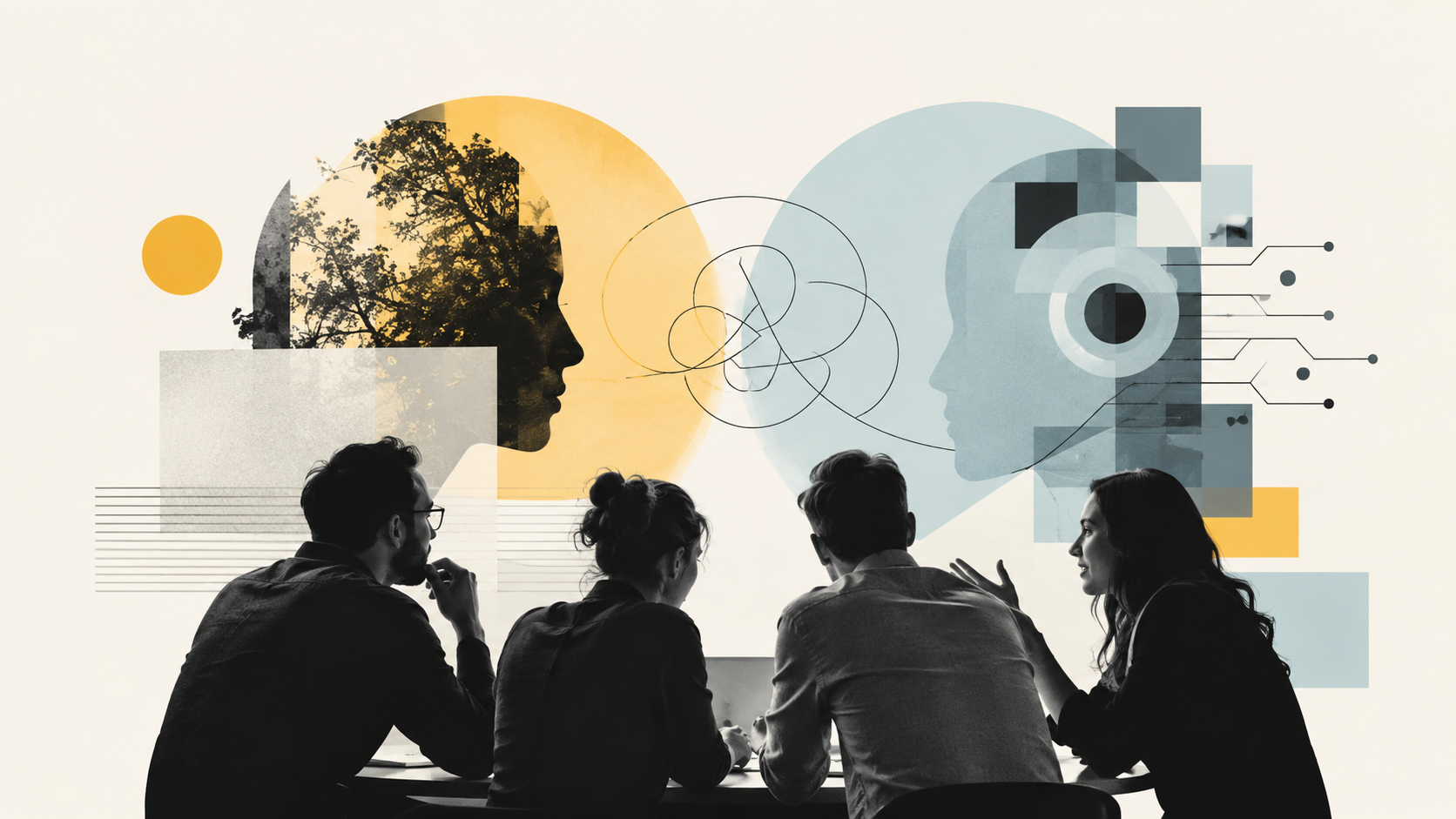
AI is becoming part of how we write, analyse, create, plan and make decisions.
So organisations naturally ask:
How do we help people use AI better?
In Human Magic: Leading with Wisdom in an Age of Algorithms, Johan Roos adds another question:
What happens to our own capabilities as AI becomes more capable?
His argument is not about resisting AI. It is about how we use it.
Technology can amplify distinctly human capabilities - or gradually erode them if we stop exercising them ourselves.
Roos focuses on five: curiosity, creativity, critical thinking, communication and collaboration, connected by practical wisdom.
This direction is also visible beyond the book. The World Economic Forum expects human capabilities such as creative thinking and curiosity to grow in importance alongside AI and technology skills.
So, what deserves particular attention?
1. Curiosity
AI makes answers incredibly easy to get.
The risk is stopping at the first one.
Curiosity asks:
Why? What are we missing? What else could be true?
Roos frames the shift as moving from quick answers to deeper questions.
AI can give us answers. Used well, it can also help us test assumptions, explore alternatives and ask better questions.
2. Creativity
AI can generate ten ideas in seconds.
But quantity is not originality.
Creativity still involves making unexpected connections, challenging assumptions and bringing context, experience and imagination into the process.
Roos contrasts polished outputs with original insights.
AI can expand the possibilities.
Humans still need to recognise which ones are worth pursuing.
3. Critical Thinking
As AI becomes more convincing, questioning its output becomes more important.
Is it accurate?
What assumptions sit behind it?
What evidence is missing?
What else might explain this?
Roos describes this as moving from shallow reasoning to clear judgement.
Workplace research supports the same direction. Microsoft's 2026 Work Trend Index found that quality control of AI output and critical thinking are becoming increasingly important as AI takes on more work.
The faster we can generate an answer, the more deliberate we may need to be about evaluating it.
4. Communication
AI can draft an email, summarise a meeting and improve a presentation.
But communication is more than producing good sentences.
It requires understanding the audience, reading the context, deciding what matters and communicating with intention and credibility.
Roos describes a shift from data dashboards to hybrid authority — where human judgement increasingly exists alongside machine-generated information.
The question is not simply whether AI can communicate for us.
It is whether using AI helps us become better communicators ourselves.
5. Collaboration
AI can make individuals faster.
That does not automatically make teams better.
Complex work still requires different perspectives, disagreement, trust and shared ownership.
Roos describes the move from human teams to bionic collaboration — where human and technological capabilities increasingly work together.
This creates a new collaboration challenge:
What should people do? What should AI do? And how should the two work together?
Practical wisdom connects them all
Knowing what AI can do is not the same as knowing what we should do with it.
That is why Roos places practical wisdom at the centre of the five capabilities.
When should we use AI?
When should we question it?
When should we deliberately work without it?
And when does the final judgement need to remain human?
These decisions become more important as AI becomes embedded in everyday work rather than remaining a separate tool.
Amplification or erosion?
This may be the most useful idea in Human Magic.
Instead of asking only whether we use AI, we can ask:
What is using AI doing to us?
Does it make us more curious - or more satisfied with the first answer?
More creative - or more dependent on generated ideas?
More critical - or more likely to accept a convincing response?
Better communicators - or less connected to our own voice?
Better collaborators - or simply more efficient individually?
The point is not to protect human capabilities from technology.
It is to develop them alongside technology, deliberately.
That fits a broader shift in the world of work: technological and human capabilities are becoming more important at the same time, rather than one simply replacing the other.
Perhaps organisations therefore need one more question on their AI agenda.
Not only:
How can we become better at using AI?
But also:
How can using AI help us become better at what remains distinctly human?