
Why LEGO® Serious Play® Delivers Outstanding Results
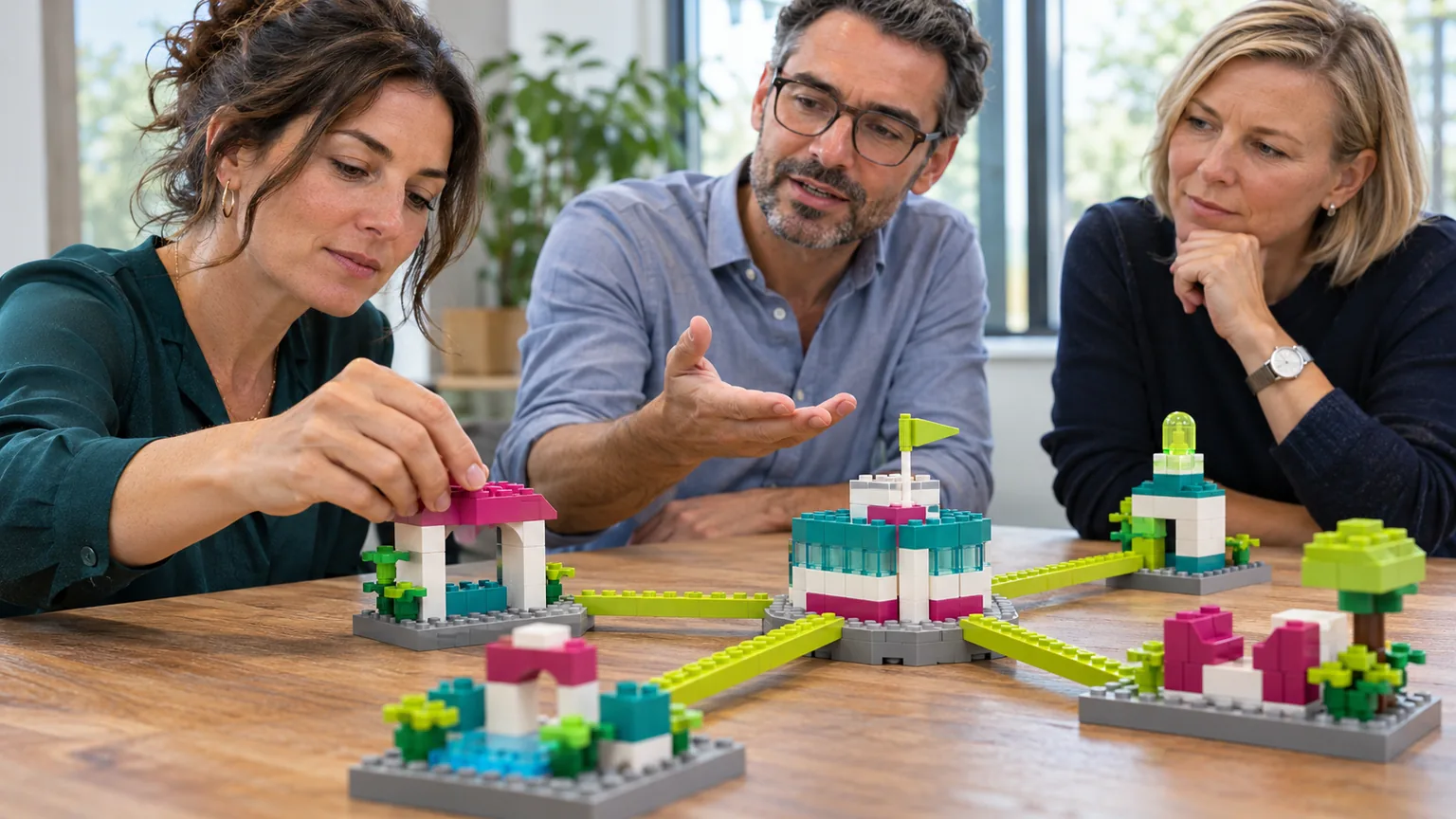
A workshop’s value becomes clear when people return to work. Do they understand the challenge differently? Can they explain their decisions and act on them together?
Just one of the numerous examples of the power of LEGO® SERIOUS PLAY® (LSP) to deliver outstanding results:
In our work with OpenText’s Bulgarian Sales Operations team, a half-day LEGO® SERIOUS PLAY® (LSP) workshop brought individual perspectives on the team’s identity and strengths into a shared direction. The team left with a prioritised action plan and clear owners, and began implementing it the next day.
What makes that progression possible? Five connected qualities explain why the method can achieve more than an interesting conversation.
More knowledge informs the decisions
Everyone builds, and everyone explains their model. Each person develops a response before the group discusses it, making room for knowledge that might otherwise be overshadowed by seniority or confidence. lego.com
Building, storytelling and questioning also give participants an active role throughout. Play encourages curiosity; a well-matched challenge can sustain the absorbed attention described as flow. Participation and focus work together: more of the group’s experience becomes available for shared judgement. Inthrface
The group discovers what needs attention
Building is not simply a way to illustrate an answer already formed. Arranging and connecting pieces can help people develop their thinking, revealing assumptions, tensions and relationships they had not yet articulated. This reflects a central learning principle behind LSP: making something tangible gives us something to examine, question and reinterpret. Models and metaphors also provide a shared reference across professional languages, helping people explore what lies behind different interpretations. Inthrface
For example, a team exploring delays might discover that unclear handovers, rather than individual performance, deserve attention. That changes the problem it needs to solve, not just the solution.
The feedback from OpenText captures the value of building before discussing:
“We built first, and then we talked - it made expressing complex ideas much easier and more natural.”
Options become clearer in their wider context
Connecting models allows a group to examine how people, processes and external pressures influence one another. Strategic imagination adds another dimension: describing what exists, questioning its assumptions and exploring what could be different. Scenarios can be changed and compared before committing resources, helping people consider consequences and alternative responses without implementing every possibility. This supports judgement; it does not predict the future or replace business evidence.
With Moto-Pfohe, we combined LSP with customer journey mapping to connect retail operations, brand management and corporate marketing. The work focused on relationships between activities across the customer journey and produced a shared view of growth opportunities, alongside initiatives, responsibilities and next steps.
Shared understanding supports ownership
Co-creation lets people examine how their contribution relates to the whole. They can understand not only what has been agreed, but the reasoning behind it and their part in making it happen. Shared understanding need not mean identical views: differences can remain visible rather than disappear into superficial consensus. lego.com
In our workshop with the leadership of HP Inc.’s “Do Good” volunteer community, the group developed a shared understanding of its mission and prioritised steps to strengthen alignment and engagement.
Facilitation connects insight to action
The business question, choice of participants and sequence of challenges shape what a workshop can achieve. A skilled facilitator protects participation, invites deeper reflection and helps the group turn discoveries into useful conclusions without supplying the answers. This is what distinguishes the method from simply putting LEGO bricks on a table.
For us, the practical aim is shared understanding and guiding principles for action, alongside concrete priorities, decisions and next steps. Lasting organisational results then depend on what follows: leadership support, resources, implementation and review.
The useful test is what people can now understand, decide and do together.
Related reading: What is LEGO® SERIOUS PLAY®?